Providers v26.4+
Providers are external processes that connect Kubling to remote systems through the public Provider gRPC contract. They are the extension boundary between the federation engine and each source-specific implementation.
The diagram expands the provider-specific slice of Kubling’s general architecture. Client transports and the rest of the query engine are intentionally omitted.
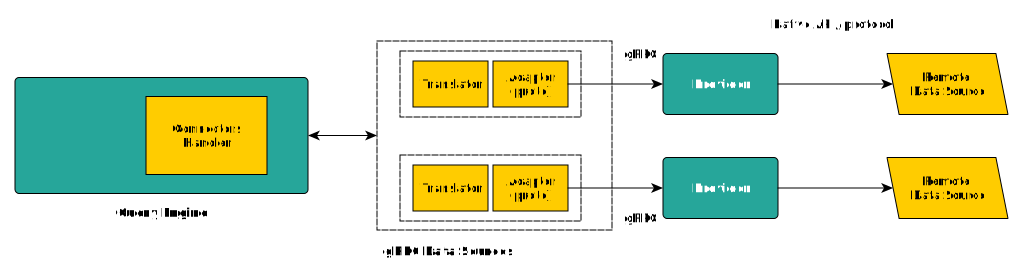
Kubling plans and coordinates the federated query. Its provider connector translates each delegated source operation into messages defined by the public Provider gRPC contract. The external provider declares the model and capabilities it supports, then translates those provider-neutral requests to the source’s native API or protocol. Source dependencies and credentials stay outside the engine.
Why Providers
The provider boundary keeps Kubling’s federation responsibilities separate from the lifecycle of an individual integration:
- a provider can add or upgrade a native client without rebuilding Kubling.
- providers and the engine can be deployed, scaled and released independently.
- source endpoints, credentials and source-specific configuration remain in the provider process.
- the capability contract lets the planner push down only operations whose semantics the provider can preserve.
- the language-neutral protocol allows a provider author to implement a provider without modifying the engine.
Responsibility model
| Kubling | Provider |
|---|---|
| Builds a federated plan across VDB models. | Connects to and configures the native source. |
| Applies VDB semantics, policies and cross-source operations. | Discovers or declares the physical relational model. |
| Decides what can be pushed down from advertised capabilities. | Translates supported logical operations to the native API or query language. |
| Evaluates expressions and operations that remain in the engine. | Executes queries and mutations, then returns typed tuples or results. |
| Coordinates engine cache, health and Soft Transaction behavior. | Reports health and optional native transaction support. |
Provider namespaces and entity names are intentionally opaque to Kubling. A provider owns their mapping to native clusters, databases, keyspaces, APIs or other source concepts. The VDB can enrich that physical catalog and define virtual models above it without moving native connection details into Kubling.
Logical connections
Kubling discovers the provider schema and capabilities before planning source operations. Query and mutation requests use a logical provider connection, and unsupported work remains in the federation engine.
The provider’s connection_id is opaque. It scopes subsequent query,
mutation and native transaction calls, but it does not expose source connection
parameters to the engine.
Provider APIs, the Go SDK and official providers are currently pre-1.0. Pin exact image versions and review compatibility notes before upgrading.
Provider catalog
Provider discovery lives in a dedicated catalog so this overview remains useful as the ecosystem grows. The catalog supports search and filters by category and type, and every entry identifies its publisher, ownership status, official documentation, source and container image.
The current catalog contains providers developed and released by the Kubling project. An Official badge describes ownership; it does not imply that a provider API has reached 1.0. Integration entries connect production data sources, while Reference entries exist primarily for development and compatibility testing.
Releases and compatibility
The protocol, Go SDK and individual providers have independent release lifecycles:
- protocol modules are published at
buf.build/kubling/kubling-providers. - Go SDK tags use the
sdk-go/vMAJOR.MINOR.PATCHform. - provider tags use the
providers/<name>/vMAJOR.MINOR.PATCHform and publish multi-platform images forlinux/amd64andlinux/arm64.
Use the exact vMAJOR.MINOR.PATCH image tag selected for your deployment.
latest is convenient for local exploration, but it is not a reproducible
production dependency. Because these components are pre-1.0, read the release
notes for protocol or configuration changes before upgrading either side of
the connection.
Provider contract
The public ProviderService is intentionally provider-neutral. It covers
seven areas:
| Area | RPCs and behavior |
|---|---|
| Discovery | GetCapabilities and GetSchema describe exact behavior and the complete logical model. |
| Semantics | GetSemanticFragment optionally returns one versioned source-local semantic artifact without opening a logical connection. |
| Connections | OpenConnection and CloseConnection manage opaque logical connections. |
| Health | Health reports readiness plus optional non-sensitive diagnostic information. |
| Queries | Query receives a logical entity, projections, filter, ordering and pagination, then streams tuple batches. |
| Mutations | Insert, Update and Delete execute the mutations advertised by the provider. |
| Transactions | BeginTransaction, CommitTransaction, RollbackTransaction and IsInTransaction are used only when native transactions are supported. |
The published protocol is the source of truth for the wire contract. Protocol source, generated Go types and the SDK live in the Kubling Providers repository .
Schema contract
GetSchema returns one complete logical schema in either of two forms:
- structured metadata, preferred by providers that discover tables and columns dynamically.
- Kubling DDL, useful for static models that need to express the schema directly.
A provider should return one form, not both. When the VDB does not define its own DDL, Kubling imports this provider schema. Structured metadata can include tables, columns, keys, mutability and an opaque namespace that Kubling returns unchanged in later requests.
Source discovery remains provider-specific. For example, Kubernetes derives tables from discoverable resources, Cassandra reads its native catalog, and Redis loads explicitly configured Hash table definitions.
Capabilities and pushdown
Capabilities are a correctness contract, not a performance hint. A provider advertises only behavior it can evaluate with Kubling’s logical semantics:
- comparison, logical, null-predicate and pattern operators.
- logical functions, never native source function names.
- ordering and explicit or natural null ordering.
- limit and offset support.
- whether queries require a filter.
- insert, update, delete and generated-value support.
- native local transaction support.
Extended capability contracts v26.5+
The provider boundary also supports:
- an optional source-local semantic fragment.
- directional logical value support plus negotiated array, spatial and LOB representations.
- individual aggregate functions plus optional
DISTINCT,GROUP BYandHAVINGsupport.
Kubling uses this information while planning. Supported work can be pushed to the provider; unsupported expressions remain in the engine. A provider may still reject an operation that is invalid for a specific table or native model, so metadata should also describe table and column mutability precisely.
These optional capabilities have dedicated references:
Register a provider in Kubling
Deploy and configure the provider first. Provider configuration controls the native endpoint, credentials, schema selection and source-specific behavior. Kubling’s VDB registers only the gRPC endpoint and engine-level behavior:
dataSources:
  - name: "inventory"
    dataSourceType: "PROVIDER_GRPC"
    configObject:
      address: "inventory-provider"
      port: 50051
      timeoutMillis: 30000
      maxArrayDimensions: 8
      maxLobChunkBytes: 262144
      maxLobBytes: 67108864
      securityConfig:
        mode: "PLAINTEXT"
      contributesToHealth: true
    schema:
      type: "PHYSICAL"
If schema.ddl and schema.ddlFilePaths are omitted, Kubling imports the model
returned by GetSchema. A VDB can still enrich the physical schema, add
constant columns, define aggregators or place virtual models above it.
Do not place native source credentials in this configObject. They belong
in provider-owned configuration or its secret-management mechanism.
Kubling configuration reference
| Setting | Default | Description |
|---|---|---|
address | localhost | Hostname or IP address of the provider endpoint. |
port | 50051 | Provider gRPC port. |
timeoutMillis | 30000 | Maximum duration of an individual provider RPC. |
maxArrayDimensions | 8 | Maximum ARRAY nesting depth accepted by Kubling from this provider. |
maxLobChunkBytes | 262144 | Maximum bytes Kubling accepts in one provider LOB chunk. |
maxLobBytes | 67108864 | Maximum bytes Kubling accepts for one provider LOB value. |
securityConfig.mode | PLAINTEXT | Transport mode: PLAINTEXT, TLS or MTLS. |
securityConfig.serverName | provider address | Expected DNS name in the provider certificate. |
securityConfig.trustedCaCertificatesFilePath | system trust store | PEM CA bundle used to validate the provider certificate. |
securityConfig.clientCertificateChainFilePath | none | PEM client certificate chain required for MTLS. |
securityConfig.clientPrivateKeyFilePath | none | PEM private key required for MTLS. |
securityConfig.clientPrivateKeyPassword | none | Password for an encrypted client private key. |
cache | disabled | Engine-side data-source cache configuration. |
softTransactions | disabled | Engine-side Soft Transaction and simulated MVCC configuration. |
contributesToHealth | true | Makes provider health part of the overall engine health. |
timeoutMillis must be greater than zero. It applies to an individual provider
RPC; select a value that accounts for source latency and the provider’s own
native timeouts.
Transport security
PLAINTEXTprovides no transport encryption. Restrict it to loopback, private development networks or another explicitly trusted boundary.TLSauthenticates the provider endpoint to Kubling. UseserverNamewhen certificate identity differs from the configured network address and supply a private CA bundle when the system trust store is insufficient.MTLSalso authenticates Kubling to the provider endpoint and requires the client certificate chain and private key.
The endpoint exposed to Kubling must support the selected transport mode. Official provider binaries currently expose their gRPC listener directly in plaintext; use a trusted network boundary or a TLS-terminating proxy when TLS or mTLS is required.
Cache and Soft Transaction settings remain engine-level
concerns and can be configured on a PROVIDER_GRPC data source when their
semantics fit the provider.
Deployment and operations
Providers are regular services. A provider may run beside Kubling, as a sidecar, or as a separately managed service, provided Kubling can reach its gRPC endpoint and the provider can reach its native source.
Choose the process boundary from the provider’s configuration model. The official Kubernetes provider intentionally represents exactly one cluster, so multi-cluster federation uses one provider instance and one Kubling data source per cluster. Other providers may expose several configured namespaces through one process.
For production deployments:
- pin the provider image version independently from the Kubling version.
- mount provider configuration and secrets read-only where practical.
- expose the gRPC listener only to intended Kubling instances.
- set provider-native timeouts below or consistently with
timeoutMillis. - decide whether provider readiness should affect overall engine health with
contributesToHealth. - validate schema and capabilities during every provider upgrade.
When contributesToHealth is true, an unhealthy provider makes Kubling’s
aggregate health unhealthy. When it is false, provider errors still surface
to callers, but its health result is excluded from that aggregate decision.
Queries, streaming and transactions
Query results are streamed as batches so a provider does not need to construct the entire result in memory. The request’s batch size is a preference; the provider selects the actual batching strategy.
Native transactions are optional and scoped to a logical connection. If a provider does not advertise them, Kubling never treats the provider as if it had committed or rolled back native source state. Kubling’s Soft Transactions are a separate engine mechanism and should be enabled only after validating the provider’s mutation and row-identity semantics.
Build a provider
Implementations are not restricted to Go. Any service that implements the published gRPC contract can act as a Kubling provider.
For Go projects, start with the official Go SDK . It wraps transport and connection lifecycle details behind regular Go interfaces. The In-memory provider is the executable reference for the complete contract.
A provider implementation should:
- define its provider-owned configuration and secret boundary.
- expose one coherent logical model through
GetSchema. - declare conservative, exact capabilities.
- implement logical connections and release their resources reliably.
- stream typed query batches in projection order.
- report precise table, column, mutation and transaction behavior.
- pass direct gRPC and real-Kubling compatibility tests.
The repository’s contribution guide describes the expected lifecycle, validation and release structure for a new provider. The provider testing guide covers direct contract checks and a real Kubling compatibility harness.
Migrating from built-in integrations
Kubling 26.4 removed the built-in KUBERNETES, REDIS and CASSANDRA data
source implementations. Existing VDBs must move native configuration to the
corresponding provider and register it as PROVIDER_GRPC. This is not only a
type rename: ownership, discovered schema and supported operations may differ.
Follow the 26.4 provider migration guide before upgrading an existing deployment.